Revitalising the spirit of Multilateralism? The SCO’s Strategic Turn at the 2025 Tianjin Summit
Dr. Aamna Khan
Security Analyst
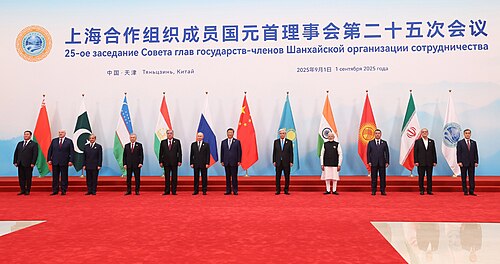
The modern global order is defined by changing power relations and increasing discussions regarding the efficacy of conventional multilateral institutions. The Shanghai Cooperation Organisation (SCO) held its 25th summit in Tianjin on September 2025, and has become a prominent regional entity striving to reinvent multilateralism. Academic research in international relations proposes an array of perspectives for assessing such advancements. Following Robert Keohane, liberal institutionalists see international institutions as tools for fostering collaboration, institutionalizing norms, and lowering transaction costs. Realists, on the other hand, frequently view these groups as nothing more than mirror images of the interests of big powers, with collaboration acting as a front for the projection of power. Constructivists, meanwhile, underline that institutions like the SCO are also social platforms that establish shared norms and identities among historically varied governments. These theoretical discussions offer a helpful context for examining whether the SCO's development is primarily symbolic and conceals power imbalances between China, Russia, and smaller member states, or if it truly represents multilateral innovation. Significant insights into this developing debate were provided by the Tianjin summit.
China aimed to advance the SCO beyond security cooperation into organized economic and institutional integration with President Xi Jinping's promise of billions in grants and loans, a long-term development strategy for 2026–2035, and a proposal for a SCO development bank. An enlarged functional agenda was indicated by the Tianjin Declaration's acceptance and the establishment of new centers to address organized crime, drug trafficking, and cyber threats. The SCO's choices to strengthen its institutional identity by streamlining its membership structure and promoting Laos to partner status were equally important. However, the SCO's political messaging is what gives it its deeper relevance. Xi, Putin, and Modi's apparent convergence demonstrated how Eurasian powers are adjusting international alignments in reaction to Western economic pressure and U.S. tariffs. The focus on AI collaboration at the summit, which is based on "equal rights" to technology advancement, represents both economic aspirations and a normative challenge to Western hegemony in digital governance. In this way, the SCO positions itself as a counterbalance and alternative to multilateralism, or what Beijing refers to as "true multilateralism," which is based on cooperation that is motivated by development, sovereignty, and non-interference. The Russian president, Vladimir Putin, reiterated Xi's comments when he said that the SCO will bring back "genuine multilateralism" since it established "the political and socioeconomic groundwork for the formation of a new system of stability and security in Eurasia." More than 20 leaders, mostly from Asia and the Middle East, convened for the summit in the northern Chinese city of Tianjin on Sunday and Monday, and Xi and Putin addressed them. With more than a dozen permanent conversation partner nations, including Saudi Arabia, Cambodia, Qatar, and Turkiye, the 10-member SCO, which comprises most of Central Asia, Russia, China, India, Iran, Pakistan, and Belarus, is viewed as an alternative power structure to the majority of US-led international organizations.
However, the crucial question is whether the SCO can turn these statements into meaningful results. Divergent political systems, unsolved boundary issues, and conflicting national interests hinder the SCO more than the European Union does. Although strategically united, China and Russia vie for dominance in Central Asia; India- Pakistan traditional rivalry; and India and China continue to be embroiled in tensions along the Himalayan border. If realism's concerns about power imbalance turn out to be accurate, China's economic influence might take over the SCO and turn multilateralism into hierarchical dependency. On the other hand, if institutionalist reasoning is correct, the SCO might progressively formalize collaboration in technology, trade, and security, acting as the most reliable multipolar governance experiment in Eurasia.
It can be concluded that the Tianjin summit signalled a shift in the SCO's development from a primarily symbolic forum to an organization looking for tangible institutional and financial tools. The SCO's ability to overcome internal rivalries, the extent to which it institutionalizes commitments beyond rhetoric, and its ability to provide member and partner states with real benefits will determine whether this represents a long-lasting shift in multilateralism or a transient political gesture. The SCO has the potential to create a distinctively Eurasian type of multilateralism that combines sovereignty and selective integration, rather than copying the European Union. The future structure of global governance will be significantly influenced by its success or failure.